Who ranks for “ap psychology unit 2”
“ap psychology unit 2” gets about 1.3k searches a month in the US. The top results are kahoot.it, knowt.com, scribd.com. The median Domain Rating on page one is DR 83, and the lowest is DR 3. To rank, you need relevant backlinks from sites like these.
92 organic results· Google estimates ~118
Google pages10/10
- AI Overview
- Videos
AI Overview
AP Psychology Unit 2 covers Cognition (in the current AP Psychology course framework, updated following College Board's redesign where Unit 2 is Cognition, accounting for roughly 15%–25% of the AP exam).
Key Topics in Unit 2
Perception (Topic 2.1): Bottom-up processing: Building perception from raw sensory data upward. Top-down processing: Interpreting sensory data using prior knowledge, expectations, and context. Gestalt Psychology: The idea that the "whole is different from the sum of its parts" (principles: figure-ground, closure, similarity, proximity, continuity). Depth Perception: Binocular cues (retinal disparity, convergence) vs. monocular cues (linear perspective, interposition, relative size). Attention & Perceptual Constancy: Selective attention, inattentional blindness, change blindness, and perceiving objects as unchanging despite shifting light or angles. Thinking, Problem-Solving, and Decision-Making (Topic 2.2): Concepts & Prototypes: Mental groupings of similar objects/ideas (concept) and the best/most typical example of that concept (prototype). Schemas: Mental frameworks for organizing expectations (updated via assimilation or accommodation). Problem-Solving Strategies: Algorithms (step-by-step guarantees) vs. heuristics (mental shortcuts/rules-of-thumb). Cognitive Biases & Fallacies: Availability heuristic, representativeness heuristic, gambler's fallacy, sunk-cost fallacy, and functional fixedness. Memory Systems & Information Processing (Topics 2.3–2.6): Three-Box/Information-Processing Model: Sensory memory → Short-term/Working memory → Long-term memory. Encoding & Storage: Shallow vs. deep (elaborative) processing, spacing effect, and long-term storage structures. Retrieval: Recall (open-ended/no cues) vs. recognition (multiple choice/cues), plus context-dependent and state-dependent memory. Forgetting & Memory Construction (Topic 2.7): Why Memories Fail: Encoding failure, storage decay, proactive interference (old blocks new), retroactive interference (new blocks old), and amnesia (retrograde vs. anterograde). Reconstructed Memory: False memories, the misinformation effect, and eyewitness testimony reliability. Intelligence and Achievement (Topic 2.8): Theories of Intelligence: General intelligence (g factor by Spearman) vs. multiple intelligences (Gardner, Sternberg). Testing & Psychometrics: Standardization, reliability (consistency), validity (measuring what it claims to), Binet's mental age, and IQ calculation. Biases & Effects: Cultural bias, stereotype threat, and the Flynn effect (rising average IQ scores over generations).
Study Resources
Review structured notes and concept breakdowns on Lumisource Unit 2 Review or Barron's AP Psychology Notes. Barron's AP Psychology Notes Test your vocabulary with flashcard decks on Quizlet AP Psych Unit 2.
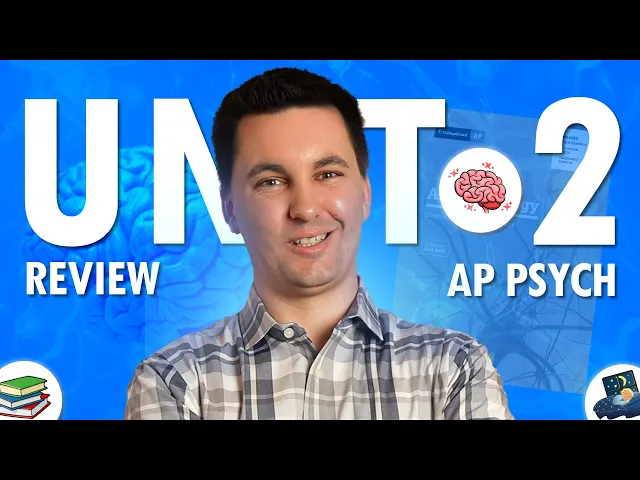
AP Psychology Unit 2 Review [Everything You NEED to Know]
Watch this complete unit overview video to review all major cognition and perception concepts for the exam: 01:02:09 AP Psychology Unit 2 Review [Everything You NEED to Know] 245K views · 2 years ago YouTube · Mr. Sinn
Would you like to focus on a specific subtopic (like memory models or problem-solving heuristics), or do you want practice multiple-choice questions for Unit 2?
Kahoot!https://create.kahoot.it › details › ap-psychology-unit-2-...
Play this kahoot titled AP Psychology Unit 2: Cognition. AP Psychology. Quiz AP Psychology Unit 2: Cognition
Knowthttps://knowt.com › note › AP-Psychology-Unit-2
AP Psychology Unit 2 · Theory—an explanation using an integrated set of principles that organizes observations and predicts behaviors or events · Hypothesis—a
Scribdhttps://www.scribd.com › document › AP-Psych-Unit2-...
The document is a comprehensive cram sheet for AP Psychology Unit 2, covering various topics related to perception, cognition, intelligence, and memory.
Videos
3 videos · SERP position 5 1AP Psychology Unit 2 Review [Everything You NEED to Know]
Mr. SinnYouTubeOct 16, 2024
 2AP Psychology Unit 2 FULL REVIEW: Cognition
 3AP Psychology Unit 2 Summary
Quizlethttps://quizlet.com › ap-psychology-unit-2-consciousne...
Unit 2 - Consciousness, Learn Test the biological clock; regular bodily rhythms (for example, of temperature and wakefulness) that occur on a 24-hour cycle. ...

Quizlethttps://quizlet.com › ... › Cognitive Psychology
Psychology Unit 2 Complete Set - Cognition (Perception, Thinking, Problem Solving, Intelligence, and Memory) Play your way to mastery with fun games Match ...
Thetawave AIhttps://thetawave.ai › ap-biology-psychology-review
Turn AP Psychology Unit 2 Review videos into notes for AP review. Review units, genetics, respiration, disorders with quizzes and flashcards. Free to try.
Perfection Learninghttps://support.perfectionlearning.com › collections › 9...
Topic 2.1: Perception Topic 2.3: Introduction to Memory Topic 2.2: Thinking, Problem-Solving, Judgments, and Decision-Making Topic 2.4: Encoding
See Which Sites Sell Backlinks
Sign up free to see all 100 results and find which domains are already selling links. Skip the guesswork and rank faster.
See All Results. It's Free.