Who ranks for “build chat application”
“build chat application” gets about 90 searches a month in the US. The top results are reddit.com, pubnub.com, youtube.com. The median Domain Rating on page one is DR 92, and the lowest is DR 9. To rank, you need relevant backlinks from sites like these.
98 organic results· Google estimates ~124
Google pages10/10
- AI Overview
- Videos
- People also ask
AI Overview
Building a chat application involves two primary components: a Frontend (the user interface they interact with) and a Backend (the server infrastructure that delivers and routes messages in real time).
Depending on your coding experience, you can build a chat app in three different ways: Coding from scratch, using SDKs/APIs, or using No-Code Builders.
Method 1: Coding from Scratch (Full-Stack)
This approach gives you maximum control and teaches you the fundamentals of real-time systems.
1. Choose Your Tech Stack
Frontend: React, Flutter, Swift (iOS), or Kotlin (Android). Backend: Node.js with Express, Python, or Go. Real-Time Protocol: WebSockets (or libraries like Socket.io ). Traditional HTTP HTTP requests are too slow because they rely on the client constantly asking the server for new data. WebSockets create a permanent, two-way open tunnel for instant updates. Database: PostgreSQL or MySQL for user profiles and message history. Redis for handling live chat state and caching.
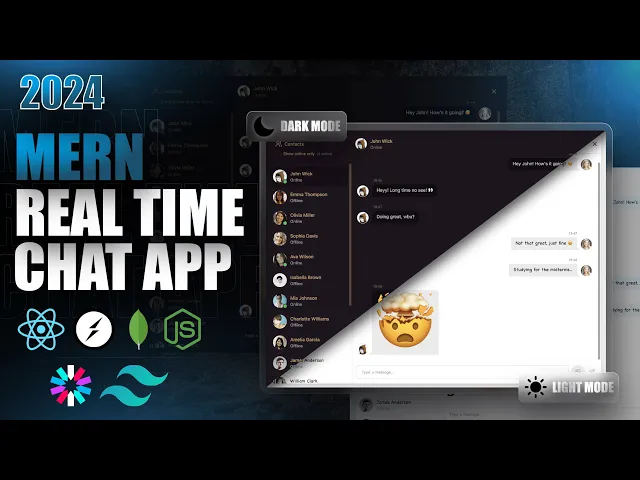
2. Architecture & Step-by-Step Implementation
Set up the Database: Create tables to store Users, Conversations, and Messages. Ensure you map relations so messages belong to specific chats. Build Authentication: Set up sign-up and login endpoints using JSON Web Tokens (JWT) to secure user identities. Establish WebSocket Connections: When a user logs in, open a secure WebSocket connection ( wss:// ) between the client app and the server. Handle Event Routing: When User A sends a message, the client emits a send_message event to the backend via WebSockets. The backend saves the message to the database. The backend reads who the recipient is (User B) and pushes the message to User B's active connection in real-time. Design the Frontend UI: Build a message history view, a text input field, a contact list, and status updates (like typing indicators or online status flags).
Method 2: Using Chat SDKs & APIs (The Industry Standard)
If you are building a commercial product, companies rarely code WebSockets from scratch because scaling them to thousands of concurrent users is highly complex. Instead, developers use specialized Cloud infrastructure.
Popular Services: Sendbird, Stream Chat, or Firebase. How it works: They provide pre-built backend servers and database management. You simply download their software development kit (SDK) to your frontend, plug in your API key, and use their ready-made UI components for typing indicators, file sharing, and thread management.

Method 3: No-Code App Builders (Fastest & Easiest)
If you do not know how to code but want to launch a functional application quickly, you can use drag-and-drop tools.
Popular Tools: Appy Pie or Shoutem. How it works: You describe the type of app you want (e.g., "a workspace chat app for teams"), pick your brand colors, and add functional features like push notifications and group channels purely through a visual interface.
Direct Comparison: Which approach is right for you?
Criteria Coding From Scratch (MERN / WebSockets) Using Chat SDKs (Stream / Sendbird) No-Code Builders Best For Learning, total customization, personal portfolios. Production apps, startups, rapid scaling. MVPs, non-technical creators, quick prototypes. Development Time Weeks to Months Days Hours Scalability Hard to scale manually; requires complex infrastructure. Built to effortlessly handle millions of concurrent users. Dependent entirely on the platform's constraints. Upfront Cost Free (except hosting costs). Free tiers available; monthly scales with active users. Monthly platform subscription fees.
Redditreddit.com
r/swift
What is required to build a messaging app? : r/swift
I am not referring to the interface, but I am asking about the core of the app itself. As I can use firebase for example to sign up users, but what can ...
r/learnprogramming
I want to make a live chat web application and I'm ...
PubNubhttps://www.pubnub.com › blog › build-chat-applicatio...
Feb 20, 2024 — To begin building your chat application in Android, download Android Studio, the official Integrated Development Environment (IDE) for Android

Videos
4 videos · SERP position 5 1Build and Deploy a Realtime Chat App with React, Node.js ...
CodesistencyYouTubeSep 11, 2025
 2How To Make MERN Stack Chat App With Socket.io
 3Real Time Chat App with Users, Rooms | Node.js, Express ...
 4MERN Stack Project: Realtime Chat App Tutorial - React.js & ...
freeCodeCamphttps://www.freecodecamp.org › news › build-a-realtim...
Aug 4, 2022 — In this article, we will be using Socket.io and HarperDB to build a fullstack, real-time chat application with chat rooms.
Facebook · React Developers1 comment · 3 years ago
Build a chat application to showcase your full-stack development skills. This is a general overview of the tools and technologies you might use ...
JavaScript in Plain Englishhttps://javascript.plainenglish.io › building-a-real-time-c...
Sep 18, 2025 — Here's a step-by-step breakdown of how I built it. 1) Project … 2) Creating the Server With Express I needed a server to host the chat app.
People also ask
- How to create an online chat?
- Is there a secret messaging app disguised as a game?
- Which chat app is most private?
- Can I create my own app for free?
Quora30+ answers · 10 years ago
How do I design and develop a chat app?
See Which Sites Sell Backlinks
Sign up free to see all 100 results and find which domains are already selling links. Skip the guesswork and rank faster.
See All Results. It's Free.