Who ranks for “llms”
“llms” gets about 110k searches a month in the US. The top results are en.wikipedia.org, ibm.com, nvidia.com. The median Domain Rating on page one is DR 93, and the lowest is DR 92. To rank, you need relevant backlinks from sites like these.
Stale SERP snapshot
Snapshot date: Sep 28, 2025. This snapshot is older than 90 days, so treat these rankings as historical.
7 organic results· Google estimates about 73,400,000
Google pages1/10
- AI Overview
- People also ask
- Videos
- Top stories
- Perspectives
AI Overview
LLMs, or large language models, are AI systems trained on massive datasets to understand and generate human-like text, forming the core of many advanced NLP applications. They function by learning linguistic patterns and context to perform tasks like text generation, summarization, question answering, and even coding. Trained using self-supervised machine learning, LLMs leverage transformer architectures and can be further fine-tuned for specialized purposes, though their development requires significant computational resources and engineering effort.
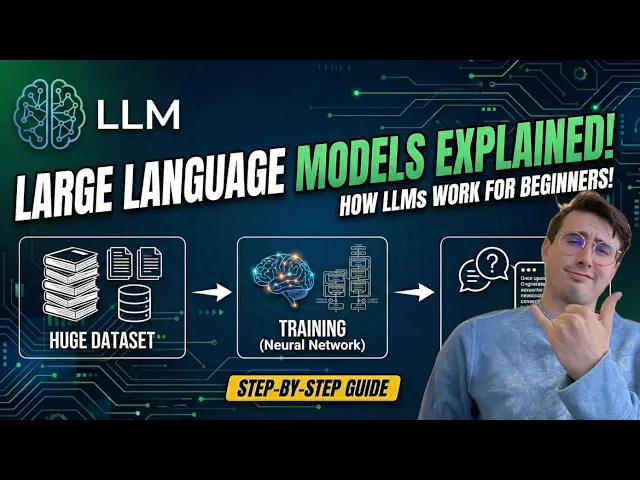
What are LLMs?
AI models for language: LLMs are a type of artificial intelligence designed to process and generate human language. Large scale training: They are trained on enormous quantities of text data, which allows them to learn complex linguistic patterns and context. Transformer architecture: A key component of their architecture is the transformer, which helps the model understand relationships between words and phrases. Generative capabilities: A defining feature is their ability to generate new, coherent text from scratch, such as essays, stories, or code, mimicking human writing styles.
How do LLMs work?
Pre-training : LLMs undergo an initial, self-supervised learning phase where they learn to predict text based on context from vast, often publicly available, datasets. Fine-tuning : After pre-training, a more specific, narrower dataset can be used to "fine-tune" the model, optimizing it for particular tasks like sentiment analysis or question answering. Reinforcement Learning: Human feedback can also be used to refine LLMs further, improving the accuracy and alignment of their responses. Inference : During inference, the model takes a prompt (input) and generates an output by predicting the most probable sequence of words.
What are LLMs used for?
Text Generation: Creating articles, stories, emails, and other forms of written content. Information Extraction: Summarizing large documents and answering specific questions from text. Coding Assistance: Generating and debugging computer code. Other applications: They can also be used to build tools for sentiment detection, image caption generation, and more.
Key Considerations:
Resources: Training the largest LLMs requires immense computational resources, time, and specialized infrastructure, making them expensive to develop. Bias: The training data can introduce biases into the model, making it crucial to monitor and mitigate bias in LLMs.
Wikipediahttps://en.wikipedia.org › wiki › Large_language_model
A large language model (LLM) is a language model trained with self-supervised machine learning on a vast amount of text, designed for natural language ...
People also ask
- What are LLMs in AI?
- Is GPT a LLM?
- What is an example of a LLM?
- Is LLM better than AI?
IBMhttps://www.ibm.com › think › topics › large-language-...
Large language models are AI systems capable of understanding and generating human language by processing vast amounts of text data.
NVIDIAhttps://www.nvidia.com › en-us › large-language-models
Large language models (LLMs) are deep learning algorithms that can recognize, summarize, translate, predict, and generate content using very large datasets.
Videos
3 videos · SERP position 7 1How I use LLMs
YouTubeFeb 27, 2025
 2Deep Dive into LLMs like ChatGPT
 3[1hr Talk] Intro to Large Language Models
Top stories
Report Finds LLMs Not Yet Ready to Replace SREs in Incident Management
Game over for pure LLMs. Even Turing Award Winner Rich Sutton has gotten off the bus.
How LLMs Work: Top 10 Executive-Level Questions | Rama Ramakrishnan
What people are saying
Google Cloudhttps://cloud.google.com › llms
A large language model (LLM) is a statistical language model, trained on a massive amount of data, that can be used to generate and translate text and other ...

Amazon Web Serviceshttps://aws.amazon.com › ... › Generative AI
Large language models, also known as LLMs, are very large deep learning models that are pre-trained on vast amounts of data.
See Which Sites Sell Backlinks
Sign up free to see all 100 results and find which domains are already selling links. Skip the guesswork and rank faster.
See All Results. It's Free.